
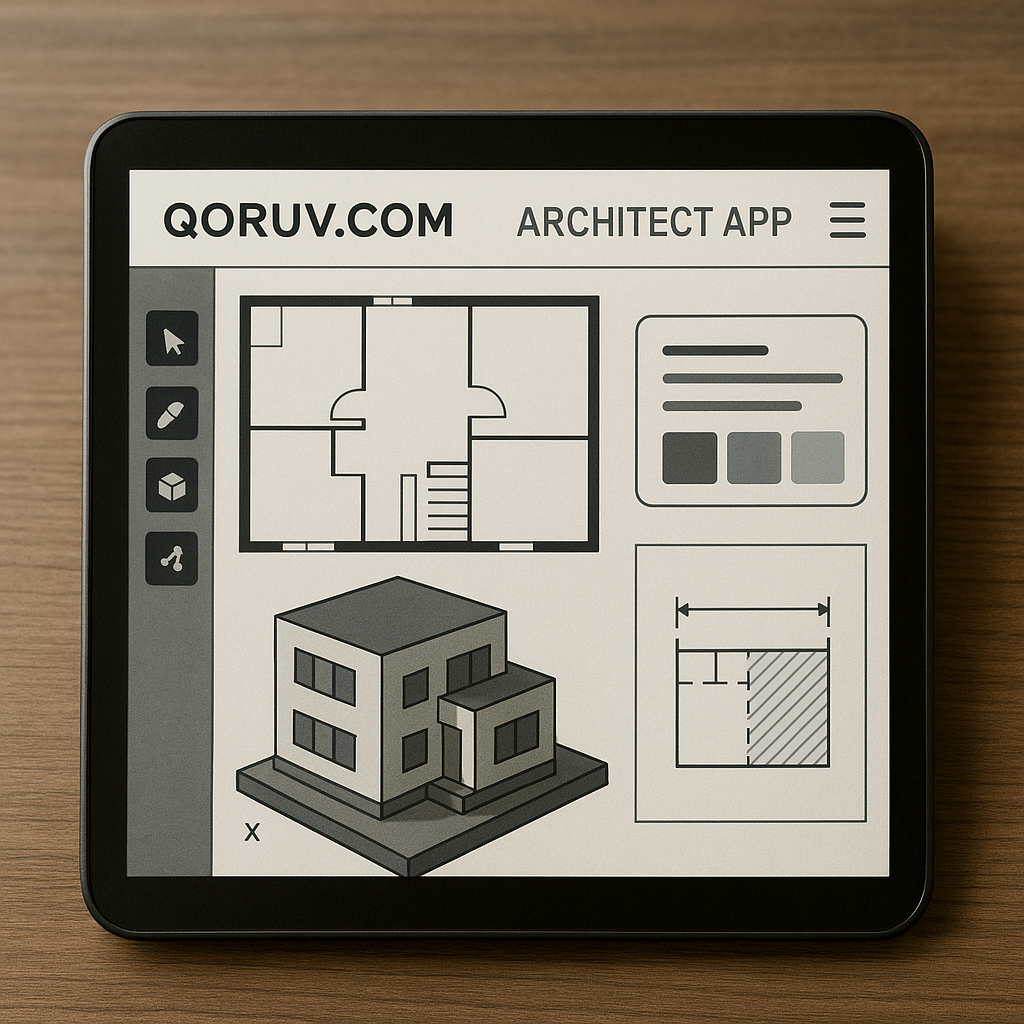
Today’s tech-driven, fast-paced design environment is drastically changing architecture. The days of architects visualizing their ideas just with 2D drawings and time-consuming physical models are long gone. Design processes are now smarter, quicker, and easier because to the convergence of artificial intelligence (AI), real-time 3D modeling, and cloud-based collaboration. The Qoruv.com Architect App, a ground-breaking digital tool that is revolutionizing the way architects plan, formulate, and carry out architectural concepts, is in the vanguard of this change.
The Architect App from Qoruv.com is more than just a digital sketching tool; it’s a full-featured AI-powered platform with sophisticated simulation tools, real-time data integration, and immersive design capabilities. It enables professionals in the fields of architecture, urban planning, interior design, and construction to create clever design solutions that maximize user experience, sustainability, and space efficiency.
The Development of Tools for Architectural Design
Over the past few decades, architectural tools have seen tremendous evolution. The industry has gradually moved toward digitization, moving from hand-drawn plans and AutoCAD software to BIM platforms and VR-enabled walkthroughs. There are still issues, though, as traditional design software frequently has high learning curves, no real-time collaborative tools, and poor integration with user behavior or environmental data.
These drawbacks are addressed by the Qoruv.com Architect App, which offers a user-friendly, AI-enhanced interface that is both powerful and accessible. It raises the bar for what architects should anticipate from digital tools by fusing the best features of cloud-based collaboration, clever ideas, and visual design into a single platform.
AI’s Place in Contemporary Architecture
The Qoruv Architect App’s smooth artificial intelligence integration is one of its best qualities. Based on local aesthetics or climatic data, the app can recommend energy-efficient setups, ideal spatial layouts, and even design components using AI algorithms.
For example, the app may suggest specific window locations or roofing materials to enhance passive cooling while planning a home in a hot environment. Depending on the time of day, it may also replicate sunlight exposure or airflow, enabling architects to design environmentally responsible and aesthetically beautiful constructions.
Early in the planning stage, AI in the Architect App also assists in identifying design conflicts or inefficiencies. By reducing the need for post-construction modifications or retrofitting, this predictive capability can save a substantial amount of time and money.
3D Modeling in Real Time: From Idea to Virtual Reality
The app’s real-time 3D modeling environment is another ground-breaking feature. In a virtual environment that changes quickly with every design modification, users can construct constructions. Wall height adjustments, floor plan modifications, and interior design additions are all shown fluidly in high-resolution 3D.
For client presentations, where non-technical stakeholders can take an immersive tour of their prospective homes or businesses, this capability is especially helpful. The software helps the client and architect communicate more clearly and expedite approvals by providing a live and interactive design experience.
Users may experience their creations as if they were physically within the area thanks to the app’s integration with virtual reality goggles. A paradigm shift in the way architecture is envisioned and disseminated may be seen in this transition from static drawings to immersive surroundings.
Data-Informed Design and Astute Suggestions
The Qoruv.com Architect App guides creativity rather than merely facilitating it. To provide intelligent suggestions, its AI engine continuously examines contextual information and human input. The software offers information on material usage, space utilization, and structural feasibility, regardless of whether the user is planning a skyscraper or a small studio apartment.
Additionally, designers can enter specific objectives, such optimizing natural light, lowering carbon emissions, or earning a certain certification (like LEED). The program then converts user preferences into quantifiable results by suggesting design approaches and materials that support those objectives.
Additionally, the platform is designed to take into account local zoning and building restrictions, warning users when their designs may go beyond permitted bounds or breach laws. Avoiding expensive reworks and bureaucratic delays may be made possible by this proactive compliance check.
Working Together in the Cloud
Building design is rarely done alone. Architects frequently collaborate with clients, contractors, interior designers, and civil engineers. The cloud-native architecture of Qoruv guarantees smooth stakeholder cooperation. A single project can be seen, edited, and commented on in real time by numerous individuals from all over the world.
With an integrated version control system that enables teams to evaluate various design approaches or go back to earlier iterations, every change is monitored and recorded. This guarantees responsibility, openness, and seamless collaboration throughout the design process.
The platform also allows teams to keep pre-approved materials, layouts, and branding components in common design libraries, which is perfect for businesses overseeing several projects or franchise-style ventures.
At the Heart of Sustainability
The Architect App from Qoruv.com is a leader in green design features in a time when sustainability is no longer optional but rather necessary. It enables designers to compute embodied carbon in materials, examine water usage, and model a building’s energy consumption.
Architects can test the effects of rainwater harvesting systems, solar panels, and green roofs on a building’s environmental impact by running “what-if” scenarios. In addition to aiding in eco-certification procedures, these simulations are useful tools for persuading buyers to choose eco-friendly designs.
In order to recommend locally accessible sustainable resources and lower the carbon emissions related to production and shipping, the platform also interacts with international environmental information.
Connectivity with CAD and BIM Ecosystems
The Architect App acknowledges the importance of current industry standards even if it is a powerful tool on its own. The application facilitates smooth export to widely used CAD (Computer-Aided Design) and BIM (Building Information Modeling) systems. This guarantees interoperability with platforms for cost estimating, facility management systems, and workflows for construction documentation.
The Architect App allows users to refine files imported from programs like AutoCAD, Revit, or SketchUp. On the other hand, finished drawings produced in Qoruv can be exported for additional refinement or sent to city planning offices and contractors.
Businesses can add the Architect App as a potent new tool to their toolset without having to completely revamp their current procedures thanks to this bidirectional interface.
Applications in the Real World and Case Studies
The Qoruv Architect App is already being used by architectural firms worldwide to optimize their workflows. For example, mid-sized businesses in urban India utilize it to quickly develop economical house plans that satisfy ventilation and space restrictions. It is used in Scandinavia to create passive homes that require little energy to endure harsh winters.
While huge developers construct multi-building complexes with integrated traffic flow and landscape schemes, interior designers utilize the software to create commercial spaces with accurate lighting simulations. The app’s adaptability and worth across scales and geographies are demonstrated by these case studies.
Design Democratization and Accessibility
The accessibility of the Qoruv Architect App is arguably one of its most significant features. Because of its intuitive and user-friendly design, the platform eliminates the obstacles that come with expensive design software. Access to the same potent tools as big businesses is available to students, small businesses, and independent contractors, encouraging innovation in the sector.
In addition, Qoruv.com has implemented a tiered subscription structure that allows for customizable pricing according to user requirements. Open-access tutorials, community outreach initiatives, and educational licensing guarantee the broad dissemination of information and resources.
Roadmap for the Future: AI-Powered Building and Beyond
In the future, Qoruv.com intends to extend the Architect App’s functionality into the domains of digital twin integration, material procurement automation, and AI-driven construction. Real-time cost tracking, supplier sourcing, and live integration with sensors on construction sites are probably going to be included in future versions.
Tools like the Architect App will serve as the digital foundation for a new era in architecture, where design and data fluidly merge to create intelligent surroundings, as cities get smarter and buildings become more responsive.
Conclusion: Using Intelligence to Build the Future
The Qoruv.com Architect App reinvents the architectural design process rather than merely updating it. AI, real-time 3D modeling, sustainability simulation, and collaborative cloud-based workflows are all combined to provide a holistic platform that facilitates quicker, more intelligent, and better-informed design decisions.
The Architect App gives you the skills to create with purpose and accuracy, whether you’re creating your first residential home or an urban megastructure. Qoruv.com offers the blueprint for tomorrow’s architects in a world where form and function must coexist and aesthetics and analytics must be in harmony.